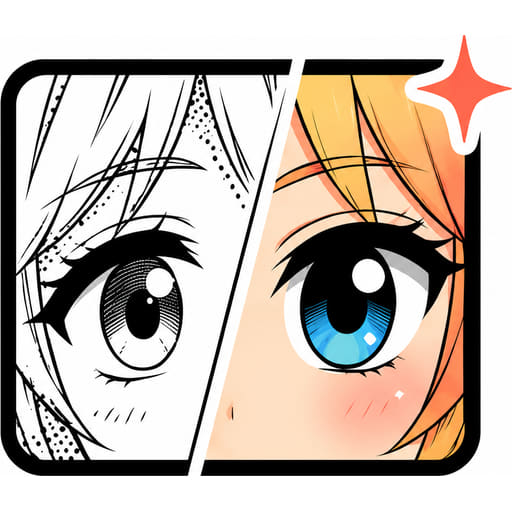

The hardest part of manga coloring is often not choosing colors. It is adding color without weakening the drawing that already makes the page readable. Eyes, hair strands, folds, speed lines, panel borders, screentones, and lettering all carry information. If a coloring pass redraws those details, the result may look polished while no longer matching the source.
A line-preserving workflow treats the black-and-white page as the source of truth. Color is added as a new layer of interpretation, while the original ink remains the reference for structure. If you want to test that workflow directly, start with the AI Manga Colorizer and keep the source page visible for comparison.
Start with a source where the lines are actually readable
Before coloring, inspect the page at full size. Thin lines that disappear in the source cannot be reliably preserved later. Heavy JPEG compression, blur, paper gray, moiré, and uneven scans can make real ink harder to distinguish from noise.
If the problem is scan quality, clean the scan first with the Manga Cleaner. Do not use aggressive cleanup simply to make the page look whiter. The goal is to remove accidental noise while keeping intentional hatching, tone edges, and small facial lines.
Tell the colorizer what must not change
A useful manga coloring instruction should define protected information explicitly. Ask the system to preserve:
- original black ink and fine interior lines;
- facial expression and character identity;
- speech balloons, lettering placement, and panel borders;
- screentone boundaries and deliberate black fills;
- pose, perspective, props, and background geometry.
Avoid broad instructions such as “improve the drawing,” “add more detail,” or “make it cinematic” when preservation is the priority. Those phrases can encourage reinterpretation instead of coloring.
Use color to support the ink, not compete with it
Strong saturation and contrast are not automatically better. Dense colors can visually bury delicate line work even when the pixels are technically still present. Start with a controlled palette and let the line art remain the highest-frequency detail in the image.
This matters most around eyes, hair, clothing seams, hands, jewelry, mechanical objects, speed effects, and backgrounds with dense hatching.
Compare before and after at 100% zoom
A thumbnail can hide structural errors. Review the source and generated page side by side at full size. Check whether a line has disappeared, moved, thickened, or been replaced by painted detail.
Use a repeatable checklist:
- Compare eyes, mouths, fingers, and hair strands.
- Check panel borders and speech balloons.
- Inspect screentones and cross-hatching.
- Look at small props and costume details.
- Confirm that lettering remains readable when it should be preserved.
If a difference changes the meaning or identity of the drawing, treat it as a failed preservation decision rather than a cosmetic variation. The AI manga coloring examples are useful for comparing how prompts, references, and generation settings map to visible results.
Separate line art only when the source needs it
Some sources benefit from extracting a cleaner monochrome drawing before coloring. This can help when the image already contains faded color, paper texture, or mixed shading. The Manga Line Art Extractor is useful when you need a clearer line-based working reference.
Line extraction is still a transformation. It can simplify painterly edges, fine tone transitions, or weak contours. Always compare the extracted layer with the original before using it as the new source of truth.
Preserve text unless your workflow requires re-lettering
Do not remove text simply because the page is being colored. If the original lettering should remain, preserve it during coloring. Remove text first only when you are preparing a translated or re-lettered edition. For that workflow, use the Manga Text Remover before rebuilding the final lettering.
When text overlaps hair, clothing, or scenery, removal requires reconstructing hidden artwork. That reconstructed area should be reviewed separately before coloring.
What a successful line-preserving result looks like
A successful result should still read as the same drawing when viewed in grayscale. Color may change the mood, lighting, and material separation, but the pose, expression, ink structure, panel geometry, and story information should remain recognizable.
The safest workflow is conservative: keep the original, make the smallest necessary cleanup, color one representative page, inspect it closely, and only then reuse the approved direction on more pages. For the full production sequence, see the AI manga coloring workflow from scan to review.
Can AI preserve manga line art perfectly?
No workflow should assume perfect preservation. Generative systems can alter small shapes even when the overall result looks correct. That is why the original page should remain available for direct comparison.
Should line art always be extracted before coloring?
No. Clean black-and-white manga can often be colored directly. Extract line art when the source contains noise, faded color, or mixed-media information that makes the drawing difficult to separate visually.
Does stronger color make line loss more likely?
Strong color does not necessarily delete lines, but heavy contrast, texture, and shading can make fine ink less readable. Use color and lighting that support the drawing rather than competing with it.


