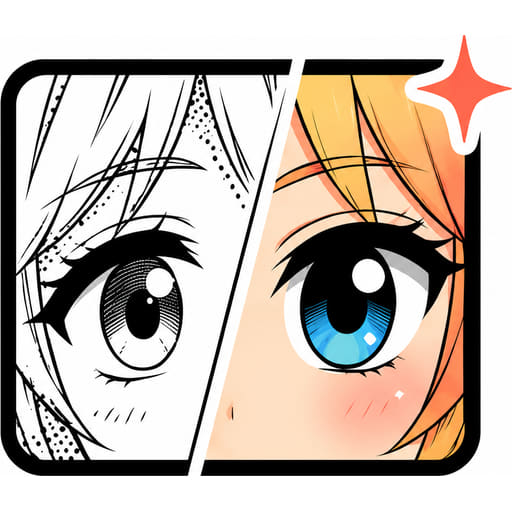

Coloring a black-and-white manga page is not the same task as colorizing an old photograph. Manga depends on deliberate ink lines, screentones, panel borders, speech balloons, speed lines, and stylized shadows. A useful AI workflow should add color around that drawing language, not replace it.
This guide explains a conservative way to color black-and-white manga with AI: prepare the source, choose a coloring direction, protect important line work, generate a first pass, and review the result before you keep it.
Start with the cleanest manga page you have
AI can work with a compressed web image, but a better source gives you more control. Prefer a straight scan or export with readable eyes, hair strands, fingers, balloon borders, and screentones. If the page contains dust, paper gray, JPEG blocks, or moiré, clean those scan artifacts before coloring rather than asking one generation to solve every problem at once.
Use the Manga Cleaner when the problem is the scan itself. Keep the original file as a reference so you can compare fine hatching and small lettering after cleanup.
Decide what the AI is allowed to change
Before generating, define the job narrowly: add color while preserving the existing drawing. A good instruction should explicitly protect character identity, facial expression, line art, panel composition, speech balloons, lettering placement, and intentional screentones.
Avoid prompts that ask the model to “improve,” “redesign,” or “make more detailed” unless you actually want a reinterpretation. Those words can encourage new accessories, altered faces, different backgrounds, or extra texture that was never in the source.
Choose a coloring direction that fits the page
Different pages need different color decisions. A quiet dialogue scene may benefit from restrained local colors and soft lighting. An action panel can tolerate stronger contrast, but the ink should still lead the image. If you know a character’s canonical hair, eye, or clothing colors, provide that information consistently rather than hoping the model guesses the same palette on every page.
For a first test, use one representative page instead of an entire chapter. Check whether the chosen direction works on skin, hair, clothing, effects, backgrounds, and screentones before repeating it.
Generate the first color pass
Open the AI Manga Colorizer, upload the black-and-white page, and start with a conservative preset. Treat the first output as a draft to inspect, not as a finished publication file.
The most important question is not “Does it look colorful?” It is “Did the color pass preserve the information already present in the manga?” A beautiful result is still a bad restoration if an eye shape changes, a hand gains a finger, a balloon border disappears, or a panel background is invented.
Check the result at 100% zoom
Compare the generated page with the source side by side. Inspect these areas first:
- eyes, mouth shapes, hair strands, hands, jewelry, and small props;
- speech balloons, captions, sound effects, and panel borders;
- screentone boundaries, cross-hatching, speed lines, and solid black areas;
- repeated character colors that need to stay consistent from panel to panel;
- background objects that could have been simplified or replaced.
If the result changes important drawing information, reduce the strength of the transformation or use a more explicit preservation instruction. Do not hide structural mistakes with stronger saturation or contrast.
When line art should be separated first
Some colored references, faded scans, or mixed-media pages are easier to work with after isolating the drawing. A Manga Line Art Extractor can create a cleaner monochrome working layer by reducing color and soft shading while keeping useful contours and interior lines.
Line extraction is not vector tracing. Fine painterly edges can simplify, and dense textures can create extra marks. Inspect faces, fingers, hair, folds, and thin panel geometry before using extracted line art as the basis for a new color pass.
When text should be removed before recoloring
If you are preparing a translated edition, it can be useful to separate image cleanup from lettering. A Manga Text Remover can remove dialogue or captions and reconstruct the area directly behind the lettering while keeping the balloon and page composition as references.
That reconstruction is generative. Text printed over hair, clothing, or scenery may hide information that no tool can recover pixel-for-pixel. Keep the untouched page beside the cleaned version and review every reconstructed area before adding translated lettering.
A reliable manga coloring workflow
For most pages, the safest order is simple: preserve the original, clean scan defects if necessary, extract line art only when the source needs it, color one representative page, review at full size, and then repeat the approved direction. See the dedicated AI manga coloring workflow for a stage-by-stage production checklist.
Do not run every tool on every page. Each extra transformation creates another opportunity to change intentional artwork. Use the smallest workflow that solves the actual problem.
Can AI color manga automatically?
Yes, AI can generate a useful color pass for black-and-white manga, but “automatic” does not mean “no review.” Models can infer plausible colors and lighting while still changing small visual facts. Human comparison is especially important for recurring characters, readable text, hands, detailed costumes, and story-relevant objects.
Does AI preserve manga screentones?
It can preserve many screentone boundaries when the source is clear and the prompt treats them as intentional artwork. Dense tones can also be interpreted as texture or shading. If the original tone pattern matters, compare the result at 100% and keep the untouched scan.
Should I remove manga text before coloring?
Not always. If the original lettering should remain, keep it and tell the colorizer to preserve it. Remove text first only when your workflow requires re-lettering or translation, and review any artwork reconstructed behind the removed text.
What is the best image format for manga coloring?
A clean PNG or high-quality WEBP usually preserves thin lines and screentones better than a heavily compressed JPEG. Resolution and source quality matter more than the file extension alone. Avoid repeatedly saving the same page through lossy compression before processing it.
Final check before you publish
Keep the original page, the cleaned or extracted intermediate file if you created one, and the final color version. You can also review AI manga coloring examples to compare visible results with their prompts and generation settings. Compare them at the intended reading size and at 100% zoom. AI manga coloring works best when it is treated as an assisted production step with a clear source of truth—not as permission to redraw the page invisibly.


